Friday, 14 September 2018

Day(s) of the Triffids


 If you go down to the woods today, you're sure of a mild surprise.

 Alright, so it's not very catchy, or even particularly alluring, but it's more honest than promising teddy bears that live in the forrest hanging out in their furry little gangs. George Lucas explained what woodland teddybears get up to in 1984 and it's a hell of a lot more violent than eating sandwiches.


Never forget...


 When I went out in the woods near Brecon recently, my fiancee noticed a tree which had grown to almost totally swallow an old sign. I thought it was mildly interesting and so naturally took a picture and posted it to the Reddit page /mildlyinteresting.


 Twenty five thousand upvotes later, and I can cross "front page of Reddit" off my bucket list. I've also been bombarded with comments saying that it looks like a vagina/butthole (it does), comments mimicking Jeff Goldblum's "life finds a way" line in Jurassic Park, and above all else, comments asking what this mysterious and almost-vanished sign actually said.

 First and foremost, the tree in question is on private land, so I couldn't exactly grab an axe and try to excavate it - at least not legally. Luckily, another group of Redditors began to try to crack the code, the best guess being from a user named busy_yogurt who suggested that the original text might have read "HORSES HAVE RIGHT OF WAY, PLEASE MAKE ROOM FOR THEM."

 This seemed like a pretty solid guess. I had no way of telling how old the sign was - the paint was still in pretty good condition but the letters had serifs - the little extra lines at the edges of letters. Nobody prints modern public information signs with serifs (I imagine because it saves on cost to exclude them) so the sign couldn't be that recent. I had no idea how old the tree was, or what species. The leaves looked to me like maple, but that's only because they looked like the Canadian flag, and that level of expertise should prove I'm no kind of arborist.

 Today, prompted by my own curiosity and that of the internet, I went back out to look at the sign again. The first thing that struck me was that the font used didn't look as antiquated on close inspection as I'd first thought. Also, careful viewing from different angles showed that it almost certainly contained "MAR-" and "-ATH." My guess was that this was therefore something about sticking to the MARked pATH.


 I walked a mile or so until I came to the nearest farm to see if they owned the path in question and if they could shed any light on things. I made my way down the drive and came across the farmer, dourly pouring red diesel into a lawnmower that was ten years older than me and at least as rusty.

 "I wonder if you could help me," I began in my best cheerful tone. "The path on the other side of the river, the one that says Footpath Only, do you own that?"

 "Yep."

 This was not by any stretch the least talkative farmer I'd ever met.

 "There's a sign at one end of the path that's been almost completely swallowed by the tree behind it..."

 "The one that says 'No Path' ?" he said. It wasn't quite a question. One sign at the far end did indeed say "Private - No Path." The gate at the other end bore the slightly more accomodating legend "Private Land - Footpath Only."  That whole section of the trail had done a perfect job of keeping the public slightly unsure of whether or not they were even allowed to be there, which I'm sure was the point. They could legally walk there, but weren't totally welcome.

 "No..." I said, "the other end. There's a red sign."

 He looked at me the way all farmers look at people - in a way that says "Why are you wasting my time with this? I have farming to do..."

 "...I took a picture of it and posted it to the internet," I explained. "Since then a lot of people have wondered what it used to say?"

 "It was about sticking to the path," he nodded.

 "Right!" I said, encouragingly. "I thought I could make out something about 'Marked Path,' maybe? Like 'Please stick to the marked path' ...?"

 "Yep. I can't remember the exact wording, but it was to tell people to keep to the perimeter path."

 I thanked him for his help and left, considering as I did so that the perimeter path was hopelessly overgrown and that everybody had been ignoring that sign and traipsing through the middle of this guy's field since long before the tree grew over it.

 It was as close to solving the mystery as I was ever going to get - if I went back and chopped a lump out of the tree to get to the exact wording, that farmer was going to have a pretty short list of suspects.

 I can only hope that he never figures out who came back later and did this:


Sunday, 29 July 2018

"Killer Magic" : Deadly Stupid.

 If the job of a magic show is to astonish, BBC Three's "Killer Magic" did the job. My jaw was on the floor within five minutes.

Not over the magic, you understand, but over the show itself. I defy you to find a program so hacky, irresponsible and sexist without resorting to Saudi Arabia's version of Jackass.

This is a show which aimed to pit top magicians against one another, but then seemingly ran out of time or money or ambition and instead hired four middling performers to do the sort of tricks you can buy for a tenner on most magic websites.

Then, the producers decided to shamelessly lift the writing and editing style from "Now You See Me," the godawful magic/heist movie from 2014.

For those who have mercifully been spared from watching the film, it focuses on four magicians, each of whom is a specialist in one "type" of magic. Mentalism, card manipulation, etc etc.

"Killer Magic" attempts to replicate this, except none of the magicians on the show seem particularly good at anything. Consider card manipulators like Chris Ramsay and then wonder why, if that's the level of YouTube talent available, the BBC went with these four losers.

Three losers, actually. Some sympathy should be spared for Jasz Vegas, a woman magician in what is traditionally a painfully male-dominated game. She has almost certainly had enough shit to deal with to get anywhere at all in her career. Not that the BBC cares about this - whilst the three male performers are introduced as set personality types - "The Charmer," "The Goth" - Jasz Vegas' intro mines new depths of lazy sexism by introducing her as "The Girl."

That's it. That's the best anyone on this embarrasing dumpster fire of a show could come up with. "The Girl." One can't help but wonder what the hook would have been had one of the magicians been black...

Putting the astonishing feats of sexism aside to focus on the middling feats of magic, we somehow run into something even more offensive. The hook for each episode is that the four magicians (or three magicians and "a girl") will compete at challenges and whoever is judged to have come last must attempt a dangerous stunt.

This is utterly morally bankrupt.

Penn & Teller, James Randi and Brian Brushwood have all written and talked extensively about the morality of "dangerous" magic. Penn & Teller in particular are known for seemingly dangerous stunts, but have always adhered to Houdini's maxim that no magic trick or feat of escapology should really be more dangerous than sitting at home on the couch.

Even magicians like Penn & Teller or The Amazing Jonathan who sometimes do incredibly gory set pieces adhere to the same slapstick rules as Road Runner cartoons or Monty Python's Black Knight; horrible, traumatic injury should be treated as a painless embarassment or an awkward faux pas.

Magic should never actually trade off of danger. Only the semblance of danger.

The thinking goes something like this: In a standard trick, a magician does something which seems impossible but which actually isn't. It's a trick. The spectator shouldn't see HOW it's a trick, and should be left baffled and - hopefully - entertained by witnessing something impossible.

Escapology and "dangerous" magic work the same way. The performer does something supposedly life-threatening, but it actually isn't. It's a trick. The audience can't see how it's a trick and so are entertained by the appearance of danger.

For "Killer Magic" to openly trade off of the idea that their final stunt is genuinely dangerous is stupid and morally wrong. It says that it's okay to endanger the lives of performers (spoiler: it isn't) and it makes the audience morally complicit. If an audience wants to be excited by a seemingly dangerous stunt, that's one thing. But drawing an audience on the premise that someone might be in real danger is lazy and gross and puts you on the moral level of the creepy guy who asks kids if they want to come and see a dead body.

Using the magic angle is also disingenuous. Imagine a series in any other genre where contestants were potentially killed for not scoring enough points. It's downright dystopian. The fact that it's a magic show and therefore nothing is real is only an excuse if you acknowledge that it's a magic show and nothing is real. When your title is "Killer Magic" you dispense with that important caveat, dishonestly, right at the top of the credits.

I see from the internet that "Killer Magic," now available as a boxed set on BBC Three, was made in 2015 and only lasted one series. This means, ironically, that the series which traded off the potential early demise of contestants was brought to a sudden and messy end. And that actually does feel like a demise it's okay to enjoy.

Edit: It's since been pointed out to me that there were actually five magicians on this show. Or four and a girl. They made so little impact that there might as well have been fifty of them.

Thursday, 26 April 2018

Movie Review: Avengers - Infinity War


  It’s been ten years since Marvel launched its cinematic universe in earnest with Iron Man, a movie in which the then-unbankable Robert Downey Jr. became a superhero most people had never heard of. The past really is another country.


In the interim we’ve had Norse gods, frozen supersoldiers, the guy from Sherlock learned to do magic and we really did believe a raccoon could talk. Finally, then, we arrive at Infinity War, a film which tries to tie all of these elements together. Does it succeed?

...Not really, no.

I’m writing this in the honeymoon period that every giant movie seems to enjoy, but I don’t think this is going to be one that suffers the sort of enormous backlash that, say, Phantom Menace did. It’s not a terrible film, it’s… an okay one. Which is about the best that can be hoped for when you consider that the task was probably impossible.

Much was made of Marvel’s claim that this was “the most ambitious crossover event in history,” but it was probably true.


I said "probably."


Unfortunately, however, ambition is a poor substitute for coherence. I was one of the cynics who didn’t think that The Avengers would work (Norse gods and Iron Man? Impossible…) but I was proven wrong by a terrific movie made by Joss Whedon.

Infinity War directors The Russo Brothers are not Joss Whedon (very few of us are...) but even if Whedon hadn’t jumped ship when the studio pissed him off with their meddling in “Age of Ultron,” there is now just too much going on in the Marvel Universe for even a Whedon level skill with ensemble writing. “Spider-man: Homecoming” ended on a cliffhanger that goes totally unaddressed, “Thor: Ragnarok” made huge changes to the character that this film spends a good chunk of the runtime trying to correct (via possibly the greatest nerd culture cameo ever), and we have to deal with flashbacks, long-vanished characters returning, outer space, New York City, Wakanda, the mystic arts, nanotech, introducing Thanos (and his unamed and underwritten henchmen) and somehow, ANOTHER appearance by Gwyneth Paltrow. She's like the herpes of the Marvel Universe - every time you think they've finally got rid of her she crops up again. Even if Paltrow weren't relentlessly bland, it's hard to concentrate on a performance by a woman you suspect of having a stone egg in her vagina during any given scene.

Even if there had been a smaller cast, lower stakes and a less convoluted backstory, the film has flaws entirely it's own. For several movies now, technology has been getting ridiculous in the Avengers franchise, and Iron Man's new nanotech suit basically turns him into the T-1000. Spider-man also dons a suit that Stark Industries made for him, giving both characters ill-defined powers that really feel like they were dreamt up with an eye to selling as many different action figures as possible.

Spider-man supposedly does whatever a spider can - we have a whole song about it - so giving him a robot suit seems strange and pointless. The Avengers made much out of the point that Iron Man is nothing without his armour. To take a character who IS superhuman and reduce him to another, slightly different suit of armour is just dumb.

Dumb is actually one of the biggest problems with Infinity War. Characters constantly make plans to defeat Thanos and then fail to stick to them, or do something stupid to sabotage them. Audiences like characters who are smart and capable. Marvel used to have a lot of those, but in this film they're reduced to idiocy for the sake of plot convenience.

[[[[[SPOILER SECTION HERE WITH MORE DETAIL: Why would Gamorra ask the one person who is least likely to kill her to be the one to kill her?! Rocket or Drax would probably have done it. Why did Vision decide to leave the operating table for a fist fight when the universe was hinging on him staying put?! Why did Dr. Strange give up the Time Stone to save the life of a man he spent the entire film not getting on with?! Why is nobody on Earth surprised to see a talking, heavily armed Raccoon arrive?!]]]]]

There are good parts of the film. It has some genuine laughs (although nothing to match Hulk's "puny god" moment) and Josh Brolin is great as Thanos. And then the ending... well, the ending is far and away the best thing in the film. Try to see it before anyone ruins the shock of it.

It's not a terrible film. I was consistently entertained. It's also not a great film, except for the great ending. The Russo Brothers genuinely seem to have done the best they could when faced with a daunting number of plates to spin. That they don't quite pull the trick off was perhaps inevitable. Maybe someone else would have done better, but it’s doubtful that “Infinity War” could ever have lived up to its own hype.

Seriously, though, it's worth it for the ending.

Friday, 25 March 2016

New App "Burglr" To Launch In Weeks.


 Controversial app "Burglr," described as "a dating app for the home-invasion enthusiast" is nearing completion, according to its manufacturers.

 Allowing criminals to collate information from social media about which residents of their local area are currently on holiday, down the pub or just dicking about in ASDA, Burglr has promised to "help criminals break and enter the 21st century."

 App creator Darren Staffie, 26, has said that the idea came to him whilst being chased over a fence by an angry homeowner. "It used to be that you had to chance your arm with houses," says Mr. Staffie. "Sometimes an empty-looking gaff would have people in it, and they were seldom pleased to see people in my line of 'work.' Now, with every cunt sharing his or her location every five minutes on Facebook, you can find unoccupied houses in your local area in realtime."

 Burglr will offer a searchable range of crime-types, from a ten minute smash-and-grab robbery available because an occupant is "doing a bit of shopping lol #shopping" to a more extensive, all-the-furniture-and-copper-wiring house clearance crime afforded by a homeowner posting minute-by-minute updates of their two week trip to another country on Instagram.

 Not everyone is happy about the new app, however. "Where's the humanity?" railed career burglar Gary Doolittle. "I've been breaking into houses looking for stuff to nick for twenty years, and knowing I'm not going to be set upon by a frenzied alsation or chased by a sleepy-eyed bloke with his cock out and a baseball bat will take much of the thrill out of the job. First the self-service tills take the human contact out of shopping, now this app will take the personal touch out of self-service houses."

 The app will repeatedly launch as soon as beta testing finishes. In the meantime, it's sunny so I'm going to the park for about ninety minutes...


Monday, 18 January 2016

Movie Review: The Hateful Eight.


 Ordinarily, Quentin Tarantino films are kind of a big deal.

 In the crowded and mercurial firmament of Hollywood, Tarantino is that rarest of things, an old-fashioned star director; a man behind the camera whose name is recognised by the public at large.

 Unfortunately, this year Tarantino came something of a cropper when his new release, "The Hateful Eight," was pitted against a new film with Harrison Ford in it. And Carrie Fisher. And The Force.

 Utterly eclipsed by the goings on in a galaxy far, far away, the best chance The Hateful Eight had was of finding movie nerds who were sick of the hype surrounding Star Wars and therefore willing to watch something else.

 Ladies and gentlemen, I am that nerd. So what did I think of The Hateful Eight?

 Well, every generation a rumour re-surfaces that a well-known celebrity had their ribs surgically removed in order to better fellate themselves. Based on the new movie, I think Quentin Tarantino may have had that surgery.

 It's not just that Quentin Tarantino loves his own work, or that his films are getting progressively longer - Hateful Eight being his longest to date. It's that as his work gets more bloated and less interesting - as he becomes psychologically what Brando became physically - he seems to think he's making films that tackle Big Issues.

 Specifically, in The Hateful Eight, Tarantino is returning to the theme of race. Some time after the American Civil War, bounty hunter John "The Hangman" Ruth (Kurt Russell) is taking female outlaw Daisy Domergue (Jennifer Jason Lee) to be hanged when he runs into fellow bounty hunter Marquis Warren (Samuel L. Jackson), a black civil war veteran. Beset by a storm, they take refuge in a small general store a few miles from civilisation where the occupants (a motley crew of other Tarantino regulars) seem to be hiding something.

 So far, so trashy, but instead of making the film we would all hope for from this set-up - a tight, smart, locked-room mystery - we have a lot of clumsy material on race politics that boils down to Samuel L. Jackson being called a nigger repeatedly, usually by people who are very clear on the fact that they don't like or trust niggers.

 It's uncomrfotable, but also done so much that it becomes slightly wearying.

 Aside from the racism, there's also a hugely misjudged amount of misogyny. We're introduced to Jennifer Jason Leigh's character as someone who is wanted by the law and destined to hang, but we're never shown anything to help us understand why she's so supposedly evil. Instead, she is repeatedly beaten up by macho archetypes whilst shackled and defenseless. The general physical abuse of Daisy Domergue, combined with her ill-judged comedy name, feels gratuitous and mean spirited. Sure, she's clearly a criminal, but in the morally bankrupt Tarantinoverse there's no reason why an audience would inherently root against that.

 This same moral bankruptcy - or perhaps, if we're honest, a lack of depth in any of the characters - means that it's hard to care about the typically high bodycount or the attempted moral lesson in progress, whatever that might be. Tarantino has said that America needs to have a conversation with itself about racism, and indeed it does, but he himself should never be the man to chair the debate. This is, after all, a man who decided to retcon World War II so that Hitler was machine-gunned to death by the director of "Hostel." Tarantino should be fun and camp and exciting, not attempting serious allegories of racial tension in post-millenial America. The best that Tarantino can do for racial division in the United States is, ironically, to keep making ham-fisted movies on the subject until others get so irritated they step in and make better films just to shut him up.

 All of this aside, is the rest of the film any good?

 The cast are all on form, largely a result of being decent actors. Walton Goggins, especially, does sterling work. The plot is over-long and at one point, Tarantino himself interjects at random to narrate events in possibly the laziest piece of writing this side of me asking myself if the rest of the film was any good, just now.

 The central mystery of the film never feels particularly compelling and isn't solved in a clever way, and there's a glaring plot hole for any mystery - one character has concrete evidence that another character is an impostor, but doesn't bring it up until half the cast are already dead.

 The soundtrack, by "fuck-me-is-he-still-alive?!" Ennio Morricone is largely, in fact, stolen from other Morricone-scored movies, most notably "The Thing," which Tarantino has somewhat bafflingly claimed this movie is an homage to, and was, according to IMDb trivia, the only film he showed to the cast and crew for guidance.

 Let that sink in for a minute; Tarantino has disappeared so far up his own infallible arse that he's been explaining to Kurt Russell how to make The Thing.

 The Hateful Eight is overall a just-okay movie, too long and nowhere near as funny, clever or entertaining as it thinks it is. For a film which had its script leaked and suffered extensive re-writes, it still feels oddly rushed and unfinished.

 Most importantly, it's a film that is nowhere near as mature as it aims to be. If studios wanted to release a film that would draw a more adult audience than Star Wars, they've entirely backed the wrong horse opera. Tarantino movies, in spite of the gore and claims of grown-up themes, are made by and for twelve-year-old boy in all of us. The sooner we all remember that, the sooner we'll start seeing decent Tarantino again. Based on this evidence, we shouldn't hold our breath.

Friday, 11 September 2015

Star Wars: Revenge of the Nerds.


 It's Friday, September 11th, and as such it's a good time to reflect on the worst atrocity in living memory.

 That's right - it's been exactly one week since some nerds couldn't get the toys they wanted.

 Like most people who aren't lugging their virginity around like an over-filled steamer trunk, I was unaware of "Force Friday" - the day that the toys for the new Star Wars movies were released. All that changed when some stunningly petulant material started showing up online, written by grown men who had waited up until midnight only to find that their local Toys R Us had run out of action figures.

 It was an awkward mix of embarrassing and hilarious, and an example can be found here if you want to subject yourself to it. As the Islamic State bulldozes real-life sacred temples, and the people fleeing that destruction are so desperate that they drown in their hundreds, people were throwing their toys out of the pram about Lego. Or would have been, if they'd got there early enough to buy any toys in the first place.*

 Whilst it should be pretty clear that I don't care about Star Wars toys, I was nonetheless struck by the language people were using. Or, more accurately, the names. From the butthurt author's admission that he got a "cool Kylo Ren poster" to the wailing lament that the Funko Pops had been "decimated", I dont have the first idea what this person is talking about.

 On the one hand, sure, I'm getting older and as such can't be expected to know everything about pop culture aimed at children.* On the other hand, I try not to become completely ignorant of my surroundings. Why don't I know what a Funko Pop is?!

 The answer is that it's ridiculous to expect me to know the names of characters in a film that hasn't been released yet. Somehow, however, movie marketing juggernauts have managed to create a status quo in which I feel slightly left behind for not knowing what's going on in a film that doesn't exist yet. Effectively, I feel dumb for not being a time traveller.

 Aside from this being a depressing comment on consumerism and the movie industry, it also leaves the door wide open for shoddy writing. Think about "Raiders of the Lost Ark." The sequels all had titles involving "Indiana Jones and the...", but the first film in that series didn't because nobody knew what an Indiana Jones was. That movie had to create Indy from the ground up.

 Now, through the internet, tie-in comics and early toy releases, a lot of people apparently already know what I've had to infer from context - that the guy in the trailer with the cross-shaped lightsabre is called Kylo Ren and, judging by the poster given to nerds, he's a bad guy.

 This is a real time saver for script writers - instead of establishing a character as being the bad guy through words or actions, just release a small plastic facsimilie of him three months in advance with a little tag attached saying "antagonist."

 The same could be done with the heroes, except it already has. By bringing back the characters from the original trilogy, we don't need to worry about backstory or motivation on their side of the fence, either.

 Go far enough down this road, and we won't even need the film - just an extended toy commercial to set things up and then a general release of Lego sets so people can make up a plot themselves based on the information they've already been spoon-fed. At which point films shouldn't be released in cinemas or even Toys R Us. They'll just be flat packed in IKEA.

 I hope I'm wrong about this, and that the new Star Wars films are creatively interesting as well as financially successful, but those of us who are long in the tooth and memory can recall how promising "Episode I: The Phantom Menace" looked.

 The new films are bringing in fresh creative talent and new characters, and this is encouraging. But let's hope that the story of these new characters isn't being told on the back of figurine packaging, instead of on screen where it belongs. After all, a complete mythology can be created in the space of one movie.

 It happened a long time ago, in a galaxy far, far away...


*Yeah. I went there. Come at me, Star Wars geeks.

Monday, 20 July 2015

Wetherspoons Boss Hates All His Staff.


 There can’t be many people out there who would question the testicular fortitude of Tim Martin.

 Arguably the most successful publican in history, the man named his chain of watering holes “J.D. Wetherspoon” after a teacher who told him he would never amount to anything.

 It’s an impressively cheeky move, but nowhere near as ballsy as Mr. Martin’s statements last week, in which he bemoaned the government plans to introduce a “living wage” by 2020, in the process effectively saying that a Tory government was being too soft on the poor.

 In an Imbibe piece entitled “Wetherspoons Boss Slams Government’s Living Wage” - which could just as honestly have been titled “Millionaire Objects To Paying Waiters Enough To Survive” - Mr. Martin complains that the proposed living wage would make the job of already-squeezed pubs more difficult.

 Mr. Martin’s argument is that supermarkets, which often sell alcohol at a loss in order to entice customers before making up their profits in other areas, are making more money than licensed premises already, and can therefore afford to take the financial hit of raising staff wages. The pubs, meanwhile, would have to raise the price of drinks to cover increased staff costs and cede more ground to supermarkets, effectively pricing themselves out of the drinks market.

 At the risk of sounding like Malcolm X, this is a fantastic example of chickens coming home to roost. 


                                            Beer pump, seen here going back and to the left…


 Wetherspoons has, since its corporate inception, operated on ruthless, shark-like business practices designed to squeeze out any and all competition from local, independent businesses. It’s well known within the industry that Wetherspoons will buy beer that’s near the end of its sell-by-date at a knock-down price, for example, because they are confident that their high-volume sales will mean it doesn’t actually cross the threshold of drinkability. This means that they pay less for beer than smaller pubs, charge less as a consequence, and use their low-price/high-volume business model to crush the competition.

 It’s not just beer, either. Wetherspoons is a methodical, profit-driven engine of efficiency. Ever noticed that there’s no music playing in a ‘Spoons? Of course there isn’t. Music costs money. Why did Wetherspoons champion cask ale at a time when nobody was drinking it? Out of a deep and abiding love for the lost art of craft beer? Of course not. It was cheap to buy in, plain and simple.

 Martin defends underpaying the staff in his budget boozers by saying that a third of profits go to staff in the form of bonuses and company shares. Ignoring for a moment that two thirds of profits (about £25 million for last year) are by definition going elsewhere, the idea of “shares” is a typical corporate get-out clause that is used in place of actual money.

 How many young kids in their first bar job would have the first clue what to do with shares in a company? How many would actually know how to cash in their shares, let alone actually go through with it? These are eighteen or nineteen year old kids, many of them already struggling under the weight of tuition fees and the aforementioned tyranny of a Conservative government, who would be much happier with actual cash money in their pockets that they can spend on groceries and bills.

 For Martin to complain that supermarket practices in the sales of alcohol are unfair to the competition is an act of hypocrisy so monumental it could probably be seen from a galaxy far, far away - fitting, given than Martin seems to be modelling himself and his office décor on the Emperor from Star Wars.


                                                                  This CAN’T be a coincidence…


 In the broader spectrum, any “debate” about a living wage is an insult to millions of people. There should be no debate about whether or not companies should pay their staff enough to survive. Ever. We might as well spend out time debating oxygen allowances or whether the working classes strictly need more than 1500 calories a day.

 The proposed “living wage” has already been exposed as largely mendacitous, but to not even pay lip service to it is beyond any concept of fairness. Luckily, other recent government plans will probably sweeten the bitter aftertaste of having to pay a barmaid enough money to feed herself. Tax loopholes for large companies, which are being implemented as we speak, will see national chains like Wetherspoons receive sums of money that should be described not so much as a windfall but as more of a hurricane plummet.

 Don’t be surprised if this time next year, Wetherspoons head office is located somewhere in the Swiss Alps for tax reasons.

 And definitely don’t be surprised if the staff at your local ‘Spoons are still on the breadline.

Monday, 27 April 2015

Movie Reviews: Avengers: Age of Ultron.


 How many superheroes does it take to change a light bulb?

 Whilst I’m sure there’s an answer to that somewhere out there, Avengers: Age of Ultron does at least answer the related question, how many superheroes does it take to crash a movie?

 When Marvel announced the first “Avengers” movie, everyone was sceptical about cramming so many disparate characters into the one film. We were, of course, spectacularly wrong. Writer/Director Joss Whedon has a talent for ensemble pieces, and he managed to make a film that gave everyone room to breathe and still provided outstanding entertainment.

 Perhaps buoyed by this success – or the fact that the first film made a profit comparable to the national debt of a small African nation – Marvel has decided to add more characters for the sequel and, in the process, come something of a cropper.

 It’s not that “Age of Ultron” isn’t fun – it is. It’s not even that it’s not a good film – it’s far from a bad one. But in trying to introduce three new Avengers and a major bad guy, as well as setting up two sequels and a spin-off, and tying up the events of two separate previous movies, whilst all the while trying to add depth to existing characters, the franchise is beginning to groan under its own weight in a worrying manner.

 Who’s to blame? It’s tempting to think that Whedon’s ego is on a Hulk-like rampage – with the biggest superhero movie in history under his belt, he could have insisted on a scene where he personally urinates on a crowd of studio executives’ mothers and probably got it – but in truth, a lot of the problems stem from the complicated storylines that have begun to tie up the Marvel universe.

 First and foremost is the fact that every Marvel film of the last few years has been hinting at the “Infinity War” storyline, in which Thanos, the Mad Titan (introduced in the first Avengers flick and seen more prominently in “Guardians of the Galaxy”) attempts to acquire the six Inifinity Gems and thus rule the universe. In practical terms, this means that almost every Marvel film now has to pull increasingly hard in the direction of this grand finale. As a result, “Age of Ultron” sees the Avengers searching for Loki’s sceptre from the previous film which – no real surprise – contains one of said gem stones.

 This means that new bad guy Ultron is forced to share his screen time with the ghost of movies both past and yet-to-come, and as such comes off as under-written. This isn’t helped by James Spader’s performance as the titular robot overlord. Whedon’s knack for finding humour in unlikely places fails him here, as Ultron is often too wilfully quirky to come off as a genuine threat.

 Introduced properly for the first time (ignoring a brief post-credits scene in “Captain America: The Winter Soldier”) are the Scarlett Witch and Quicksilver, both of whom also suffer truncated character development. They’re superpowered twins who have an axe to grind with America after their home nation was bombed using artillery produced by Tony Stark/Iron Man, but once they realise that their employer, Ultron, is in fact a crazed murder-bot, they switch sides almost without mention, and don’t even bother to bring up the Stark Industries bomb that killed their parents when they’re in the same room as the man who manufactured it.

 In short, every new character feels under-done. There’s probably a joke to be made about the superhumanly fast Quicksilver feeling rushed, but I can’t be bothered to make it.

 What, then, of the more familiar faces?

 The classic line-up are all present and correct, and given ample time to show off their skills. Chris Evans’ Captain America, in particular, is given more to do after fan bitching about his underwhelming set-pieces in the first “Avengers”, or possibly after the stellar performance of “The Winter Soldier” at the box office. Mark Ruffalo is still tortured as Bruce Banner, a man whose transformation into the Hulk is as useful as it is dangerous, and Scarlett Johansson is given more room to play with the back-story of the Black Widow, delving deeper into the guilt and regret that have always been hinted at in the former child assassin.

 Chris Hemsworth, whose triceps could probably get their own spin-off film, is given little to do as Thor. He spends a good portion of the film having wandered off on a spirit quest involving a magic lake that doesn’t even come close to being explained by any part of the script.

 Most interesting (and possibly ill advised) as a story choice is Jeremy Renner’s Hawkeye, who is explored in some depth as an ordinary man struggling to hold his own on a team of superhumans and demi-gods. Renner is a fine actor, and his scenes do have resonance, but they ignore the fundamental appeal of Marvel heroes – that even the gods themselves are flawed. Having Renner fret about his issues ignores the basic point that every one of the Avengers has relatable insecurities, from Cap’s time-lost, baffled loneliness to Banner’s mortal fear of his own emotions. Giving the human member of the team the most obviously human neuroses is a major mis-step.

 The mainstay Avengers are not the only familiar faces. Sidekicks from basically every previous movie turn up left and right, with Don Cheadle’s War Machine given something to do for the first time in what feels like forever, and the Falcon turning up briefly to have a beer with Captain America and remind us all that he exists.

 Stellan Skarsgard, who presumably has a bad home life, makes the effort to turn up in yet another Marvel film for the sole reason of… Well, it’s not exactly clear. Something to do with Thor’s magic lake.

 If the complexities of handling so many characters and storylines at once weren’t enough, there is also a distinct sense that the biggest threat to the Marvel universe at this point comes from lawyers and accountants.

 Robert Downey Jr., who kicked the whole Marvel bandwagon off as Iron Man, has been hinting at retiring for some time. Both “Iron Man 3” and “Age of Ultron” have now given him final scenes that could be seen as a farewell if he gets cold feet about future sequels. Presumably, Marvel will do everything in their power to keep him on board, but the time is fast approaching when he will become prohibitively expensive, if he hasn’t already. Similarly, at least two other characters are given a way out of the next Avengers shindig, perhaps again in the hopes of keeping production costs for a sequel below a level that would make Scrooge McDuck nervous.

 Finance aside, the legal complications between studios mean that both Fox and Marvel own the rights to Quicksilver and the Scarlett Witch, hence the former turning up (played by a different actor) in the recent “X-Men: Days of Future Past.” For the record, the X-Men movie’s take on Quicksilver’s powers was far more entertaining, although Aaron Taylor-Johnson probably gives the better performance in “Ultron.”

 The inclusion of characters from the X-Men franchise* is, honestly, a bad idea. As Fox owns the rights to “super powered mutants” as a concept (yes, really…) both characters are denied their original back-story and feel unfairly shoe-horned into things, adding another layer of confusion to a cinematic universe that is already becoming far, far too complicated without the addition of real-world litigation.

 All of this bitching is, once again, not to say that “Age of Ultron” is terrible. It’s enjoyable, and at this point in time feels, for the most part, like a night spent with old friends. Just not one of the great nights. Only a good one.

 A longer run-time might have benefitted everyone involved, although perhaps the studio thought that audiences wouldn’t want to go past the two-and-a-half hour mark. This is silly, of course. It’s the Avengers, and most movie goers will literally wait in their seats to watch them eat shawarma.

 It’s a good film. It’s great to see the characters again. But things are noticeably starting to fray, and it’s worth pointing out that there has never been a decent third movie in any franchise, ever. Marvel has left itself the task of producing a final act that is epic in scale and also more tightly reined in.

 From here, it feels like a superhuman task.


*Simmer down, comic nerds, I know that one is up for debate in historical terms.


**********************SPOILER FILLED BITCHING*********************

DO NOT READ IF YOU DON’T WANT SOME MAJOR PLOT POINTS GIVEN AWAY.


 Okay, seriously, Joss Whedon? You allegedly lobbied to have Quicksilver included because “his powers will look cool” and then you kill him off?! Never mind that you created a massive legal headache and needlessly complicated the whole shooting match, you’re going to introduce a character just to kill him off?! He might as well have been wearing a fucking Red Shirt, for Christ’s sake!

 And the Vision? I already said, the whole reason Marvel works is that the characters are at once larger than life and intimately relatable. To create a Superman-esque robot is a waste of time and raises far too many issues. Or did Paul “I’m sick of just doing voice work and want my own action figure” Bettany have someone by the balls?!

 Why are most of the sidekicks black?! Does anyone else find that a bit uncomfortable?!

 Opposite point: Did we really have to go to Wakanda just to set up a Black Panther movie?! Couldn’t someone have just wondered aloud where the Vibranium was coming from and then have that as a link?! If we’re smart enough to untangle the Quicksilver debacle as an audience, we can probably take that big a hint.

 Did anyone really want to see Hawkeye’s secret wife/kids/farm?! Hawkeye is supposed to be a cynical loner, not one of the fucking Waltons!

 I get that Nick Fury always has something up his sleeve, but how exactly did he manage to hide a helicarrier?! Did he smuggle it out under his coat one afternoon before he faked his own death?

Monday, 22 December 2014

Missing In Action


 I'm currently spending my incredibly scant free time writing a blog for Imbibe.com, the drinks website.

 I'm very busy and trying to work for them, which is why I'm missing in action, not to mention missing inaction.


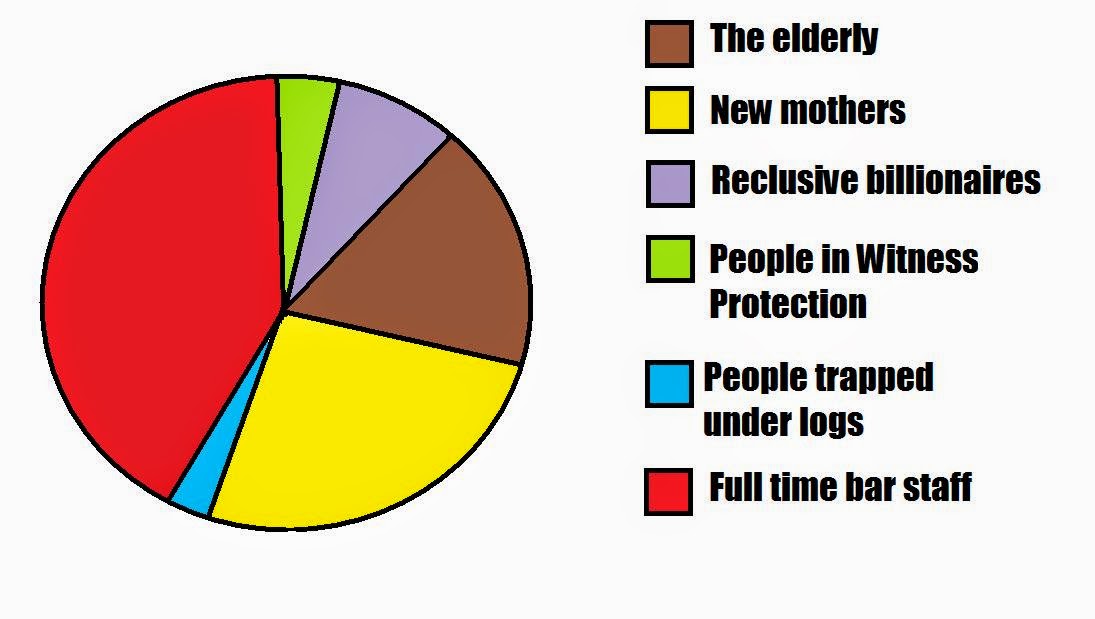
 The reason I'm so busy is demonstrated in fig. 1: PEOPLE WHO DON'T GET OUT MUCH:


And the drop in work rate is evidenced in fig. 2:


This picture is unrelated.

Wednesday, 19 November 2014

Paddington: A Nymphomaniac, Nihilist Masterpiece?


 Who's the bear that likes Marmalade sandwiches and is a sex machine to all the chicks?!

 Paddington. Apparently.

 This is what's to be inferred from the news that a new movie about Paddington Bear has been given a PG rating by censors because of sexual references.

 Those "sexual references," incidentally, consist of some bloke from Downton Abbey dressing up as a woman in one scene.

 I confess that I haven't actually seen the new Paddington film, and I suspect I never will. I'm actually allergic to any and all forms of childlike innocence. Still, I caught a synopsis of the plot on the radio earlier in a debate about the allegedly sexual nature of cross dressing.

 For the record, I don't think there's anything inherently sexual about men dressing up as women. For some reason that I've never really understood, it's a staple of British comedy and as a nation we seem to always find it uproariously funny. Sometimes it is, sometimes it isn't, but it's never remotely sexual as far as I can detect.

Not pictured: Erotica.

 What should be troubling people more is the main thrust of the story. I don't mean anything sexual by that.

 According to reports, the plot revolves around Nicole Kidman's taxidermist trying to catch Paddington and stuff him. Again, non-sexually. 

 This seems like a confused message at best, as Paddington (major spoilers for the under four demographic) is, in fact, already a stuffed bear.

 Maybe not in the movie, but he's definitely a stuffed bear any time I've seen him in person. My mother has a stuffed Paddington bear from god knows how many years ago. I've known plenty of kids who had them in my own generation.

 So what is the message, here, exactly? Is the new Paddington movie in fact some sort of gritty prequel implying Nicole Kidman eventually succeeds, murders the bear and that's why he's now lying, dead eyed and full of stuffing, in your room?! Are we trying to tell the kids that all is futile, and that Nicole Kidman is some sort of cuddly-bear terminator?! Is the message that if you're special or unique, you will be hunted until the end of your days, gutted and left as a hollow shell of what you once were?

 The existence of actual stuffed Paddington bears is implication of all this and more.

 Which is way more traumatic than Hugh Bonneville in a dress. 

 Maybe it should have been an 18 certificate.

Tuesday, 11 November 2014

He's Not Dapper, And He Doesn't Make You Laugh.


 It's been a bumper week for sexist, pencil-dicked tosspots in the news.

 First came the shocking info that professional wanker Dapper Laughs had his show dropped by ITV. Not for being crushingly un-funny, but because he'd been caught making comments at a live appearance where he said that a female audience member was "gagging for a rape."

 It's kind of ironic that the only way I could ever find Dapper Laughs funny is if he went to jail and was viciously buggered against his will.

 Hot on the heels of Dapper "Cunt" Laughs and his show being cancelled, pick-up-artist Julien Blanc was in the news as a petition to keep him out of Britain gathered momentum.

 Blanc - who calls himself a "pick up artist" because the term "sad bellend" isn't a recognised profession in a lot of countries - is one of those people who travels the world, being paid to talk to men even more pathetic and sexless than himself, riling them up with misogynist rhetoric and trying to convince them that they can be the exact kind of attractive alpha male that he, himself, clearly isn't. He was just booted out of Australia after he said that white men in Japan were free to imitate him by walking around, grabbing women by the necks and forcing their heads against his penis whilst yelling "pokemon." I promise none of that sentence is made up. Sadly.

 When you're too uncouth and sexist for Australia, it's time to take a long, hard look at your life. I digress.

 I'd quite like to see the petition against Julien Blanc succeed and ban him from the UK, but I didn't actually sign it myself as I'd really like the petition to succeed with only female signatures on it. The entire female population of a country telling him to fuck off would be the ultimate justice, and I thoroughly encourage all the single ladies (ALL the single ladies) to tell this prick where to go. And the married ones, too.

 The real question, to my mind, is not how tossers of the Blanc/Laughs magnitude exist in the first place, but what, exactly, causes them? These people don't just spring up overnight. They're a product of society, and as a member of society, I think we've all clearly fucked up if this is what we're creating.

 Possibly Laughs and his ilk are proof that "lads' mags" really did have a negative impact on the Zeitgeist. At 27, he would be smack in the middle of the generation that grew up with Nuts and Zoo as their cultural touchstones during their formative, sexually charged years. Magazines that many of us thought were harmless enough - all the time ignoring the damage they may have been doing to the minds of the stupid and gullible.

 It could also be, perhaps, blamed on the tail end of the Thatcher/Reagan years. Kids who grew up in the nineties nicked their older brothers' videos saw gung-ho, ultra-macho movies from the eighties with shirtless, indestructible bodybuilders who shrugged off bullet wounds and laughed in the face of death. Real men were ultra-tough to the point of being invincible, and it led to a hell of a crisis of masculinity in the next generation.

 It's why there are no modern action stars - nobody believes that anyone of the modern generation can be tough, which is why Bruce Willis was about thirty in Die Hard, and now when we want a hero, we still turn to a nearly-sixty Bruce Willis. Modern men are so insecure in themselves they can only really trust action heroes of their dad's generation.

 Normally this doesn't result in anything worse than a few "Taken" movies, but amongst the truly dickless and impansied* it festered and wrankled. These guys knew they were pussies. They knew they weren't macho enough. They were scared of girls, scared they'd never lose their virginities. Fear turned to hate. And hate led them to the Dapper Laughs side.

 Fans of Julien "I'm Clearly Not Happy About My Girly Name" Blanc and Dapper "Suspected Micropenis" Laughs are seemingly actual grown men who are so insecure that they need classes on how to manhandle women. Think about that. Julien Blanc actually makes a living instructing adult males who don't fancy their chances against a girl in a fight and therefore need some pointers on how to physically assault someone half their size in the completely worthless hope of somehow getting laid instead of arrested.

 The solution to the problem is twofold, at this point. Either we get all the men who don't have the balls to talk to a real-life girl, give them a rifle and a parachute and drop them over Iraq in the hopes that the ones that make it back are at least now tough enough to build their own Tinder profile, or else we do something even more unthinkable: We try to get these guys to talk to actual women.

 The ones who don't get arrested or beaten up might actually have a shot at pulling their heads out of their asses.


*Dibs on that word. I think it's an original.

Monday, 3 November 2014

Movie Review: The Babadook.


If it's in a word, or in a look, this film might have worked better as a book...

 I've been looking forward to Australian horror movie The Babadook ever since I came across the impressively creepy trailer. For those unaware, a single mother with a problem child stumbles across a strange book ("Mr. Babadook") and after reading it, begins to suspect that the monster her son is obsessed with might not be imaginary.

 And it isn't. Except it is. Look, here's the problem: the opening two thirds of this film were great. Forgoing the normal horror movie rhythm of quiet moments interspersed with jump scares, the film is one long, tense, sustained note of dread and simmering madness. Or it is until it gets stupid.

 Generally speaking I try not to put spoilers in film reviews, but I really don't think I can talk about The Babadook without discussing the last act. So, if you want to drop out now and judge for yourself, all I'll say is that I'd give it three out of five, points for effort, and label it an interesting failure.


...still with me? Good.

 As single mum Amelia becomes more sleep deprived and stressed by her son's behaviour, she begins hallucinating Mister Babadook in the shadows everywhere she looks. In probably the creepiest scene, she lies in bed, terrified, as the Babadook slowly eases open the bedroom door, skittering into the room as a jerky, stop-motion hybrid of ventriloquist doll, serial killer, insect and mammal.


 Sadly, this is also the scene where everything goes to shit, as the Babadook possesses Amelia and she begins to grow increasingly hostile to her already problematic son. Which isn't bad, as horror plots go, except that we already saw "haunted parent goes mad" done in The Shining. It would be wrong to say The Babadook is derivative, but it's definitely fair to say its influences are on show. What really lets it down, however, is thuddingly heavy-handed symbolism and a devotion to its own metaphors above plot coherence.

 The only way to make this film scary, frankly, would be to have Amelia kill her son at the climax. Instead, the son fights back with home made weapons that briefly take us entirely out of the horror genre and into a Home Alone movie. Demon-possessed mothers trying to stab their children don't normally feature in scenes that draw laughs from an audience, but damned if people weren't giggling in the screening I saw.

 Eventually, Amelia overcomes the Babadook's hold on her and in the process, learns to protect her son. Because, in case the film didn't make it abundantly clear already (and fuck me, did it), The Babadook is an expression of her repressed grief over the death of her husband and her resentment of her son. This is spelled out when, finally confronting the Babadook, Amelia is made to live out the moment of her husband's death again. Which is already un-subtle from a story point of view, but becomes outright naff when bad CGI is employed for no real reason.

 The film then takes another unexpected turn when the Babadook goes to live in the basement. Yes, really. No, I don't know why, either. One minute the Babadook is an analogy for fear and repression, the next it's a real creature, and even the film makers themselves can't decide which is the case, so eventually settle for having it live in the protagonist's basement and fed on worms from the garden. Again, I'm not making that up. We get a happy ending in which Amelia learns to get over the loss of her husband and rebuild her relationship with her son, but also has to feed the monster in her basement. Which is yet another representation of her buried emotions. Except it's not, because it's a literal monster she has to feed, because this whole film can't quite get the hang of metaphor.

 Horror is always difficult to pitch correctly. Too subtle and the audience may not cotton on, too bold and things get trashy. In the case of The Babadook, however, what should have been subtle themes are instead used to bludgeon the audience over the head. It's possible that a longer run time may have given the eerie, nauseous qualities that are present in the first half more time to breathe and resulted in a better film. It may even have worked better as a TV series, giving time for the Babadook itself to be more ambiguous, the slide into madness much slower.

 As it stands, however, the film is ultimately a great buildup to what feels like a rushed, histrionic finale that never quite trusts its audience's intelligence.


Thursday, 30 October 2014

Kicking the Porn-ets' Nest...


 Like courduroy pillows, Jennifer Lawrence's tits continue to make headlines.

 After the initial scandal of leaked nude photos, the debate has meandered on and on (and on) and, just when you thought it was safe to go back on the internet, Ms. Lawrence does an interview with Vanity Fair and the whole issue ignites again to be used as an ideological football by all and sundry like a big, burning, kickable mixed metaphor of tits.

...

 For the record, I think everything has been somewhat blown out of proportion - and not just by my Xerox machine! HIYOOO!


 ...Sorry. Look, stealing someone's stuff and spreading it all over the internet is a shitty thing to do. It's illegal. Rightly so. Someone, somewhere is guilty of a crime and should be punished. There should probably be an extra layer of punishment added for the sexual nature of the crime. Anything that happened after the initial hacking, however, has apparently descended into a witch hunt. We're all guilty of being the worst kinds of people if we even consider having a look at leaked pictures of celebrities. The deepest pits of hell are reserved for those of us who thought "hmm, cool, attractive naked women that I wouldn't normally get to see," because of course nobody thought that - the only possible motivation for wanting to see arousing pictures of attractive young ladies is that we're all hateful, misogynist scum who wish nothing but ill for the entire female race, especially those of them we had a fiver on to win an Oscar last year.

 The reality from where I sit is that a lot of people just wanted to see someone attractive without any clothes on, which is pretty normal. Not necessarily squeaky clean, morally speaking, but there was certainly never any malice in it on my part, and I'm guessing the same is true for a lot of people.

 I like Jennifer Lawrence. I think she's very, very talented. And very pretty. I also think she's over-reacting quite badly to the whole thing, if the Vanity Fair interview is anything to go by. This might be easy for me to say, as thousands of strangers have never looked at intimate pictures of me, but they theoretically could. I've taken naked pictures of myself in the past to send to various people - girlfriends, hook-ups, Grammy winning country musicians...


Weirdly, that was her exact response...


 ...and if those pictures were leaked and spread all over the place I'd be embarrassed, sure. Angry, too, probably. But I think I'd have to ultimately just shrug and say "Yeah, that's me with my cock out." It's worth bearing in mind that I say this as a non-celebrity. I'm guessing someone who picks a career being stared at by strangers probably has a lot more of the "look at me!" gene than I do, and as such would be even less flustered.

How dare we look at her naked?! Unless she's painted blue and on a 20ft screen...


 Naked pictures and videos are a fairly normal part of modern sexuality, and (again) it's totally wrong to steal those pictures and videos from people. Unfortunately, the pendulum of outrage has now swung far enough that we're being told that looking at naked strangers is always wrong.

 First there are Ms. Lawrence's comments in Vanity Fair (and let's all just take a moment to appreciate the irony of someone talking about their own naked photos and privacy in a publication whose title means "Beautiful Self Love"), in which she says that she took the photos to send to her boyfriend at the time, because he was "either going to look at porn, or look at [me.]"

 I hate to break it to you, Jen, but he did both. I abso-fucking-lutely stone cold guarantee he did. Why? Because people (male, female, young, old, gay, straight) like looking at porn. It's hard-wired into us. The idea that if you're in a relationship you should never look at porn is as silly as the idea that if I have fruit in the house I'll never need to eat donuts. I'm fully aware of which one is healthier and more wholesome, but sometimes you just want a donut. Sometimes you don't want to light incense, drink wine and seduce your partner. Sometimes you just need to jerk off and then get on with your day. I'm sure a lot of women do exactly the same thing, whether they'd admit it or not.

 Sadly, the Vanity Fair interview was seized on by a group called Fight The New Drug, an anti-porn group who believe that all forms of pornography are damaging to society and evil and probably giving you hairy palms. In an open letter to Ms. Lawrence that has, in the words of Lisa Simpson "a creepy, Pat Boone-ish quality to it," they try to argue that all porn is exactly as morally wrong as stealing someone's private images; you can tell they're down with the kids because they're super keen on using words like "super" a lot.

 The truth is that people like watching other people fuck. We always have. Porn is largely just an extension of sexual fantasy - we just have the technology to put our imagined sexual scenarios on film these days. Saying that all porn is evil and degrading is like saying the early work of the Lumiere brothers was degrading and exploitative to trains.

 Are there types of pornography that are degrading and dangerous? Yes. In news that should shock nobody except the Puritans at Fight The New Drug, however, most people don't like porn that is violent or harmful.

 Personally, I watch porn. Not because I'm a single man who works six nights a week and therefore has a presence on the dating scene about on a par with the Pope; just because I'm normal and ALL NORMAL PEOPLE WATCH PORN. I don't want to see women getting mistreated. I don't even find it sexy when it's a barbie-looking woman with ill-fitting concrete tits and a borderline eating disorder staring dead-eyed into a camera and grunting too much, which seems to be the image most anti-porn lobbyists have in their heads. What I tend to look for is clips where the woman actually looks like she's enjoying herself, because that's also what I aim for in real-life sex.*

 So, Jennifer Lawrence is wrong to think that there's anything to worry about if her boyfriend watches porn. There's nothing wrong with watching it, everyone does it, everyone masturbates (including several of the more intelligent animal species) and she needs to chill out about that. That being said, she's a fantastic actress and doesn't deserve to be robbed and have her pictures strewn around cyberspace.

 Whoever hacked Jennifer Lawrence's pictures is the real bad guy here. It was a shitty thing to do, it should be punished, they shouldn't have anything to feel good about. Anyone who looked at the pictures doesn't have much of a moral high ground, but it's human nature and I totally get why people looked.

 The people at Fight The New Drug are the sort of creepy, narrow-minded, sexually repressed types that love to proselytize to the rest of us about how we should think, feel and fuck each other. I'm not legally allowed to say that I think they're all into some weird shit, bedroom-wise, but I'll just mention that anyone who takes up a moral crusade about what other people do with their genitals usually gets caught six months later in a public toilet doing something untoward. 

 All of this furore has ultimately been created over pictures of tits and asses - apparatus owned by 51 and 100% of the population, respectively. Can we please move on now?


*Results may vary.

Sunday, 26 October 2014

Icelandic Saga


 When I’m not working in a bar, I maintain a steady sideline as an investigative journalist. Or at least that’s what I tell women at parties.

 Mostly, I just make stuff up. This is one of those times.

 I had a tip that there was an entertainment industry whistle-blower with a huge story that was looking to talk to someone trustworthy. Luckily, everyone trustworthy was too slow, so I went to meet with him instead. In a darkened back room of a shady pub, I met my contact.

 He was a grey-haired, doughy man who could have been anywhere between thirty five and fifty – whatever weighed on his mind had taken its toll on his body, and he had the fleshy, jowly look of a man gone to seed. In spite of his bulk, his eyes were furtive; the kind of eyes I’d seen most often in skinny, strung out guys. He looked like a thin, nervous man, the weight of whose secrets had been made flesh and trapped him physically as well as psychologically. He lit another cigarette as I switched on my tape recorder.

 “You promise me you won’t use my name?” he asked, quietly.

 “I’ll keep your identity an absolute secret, Dr. Williams,” I said, making a mental note to edit that part out before I publish this. I had a feeling I’d probably forget.

 “What did you want to talk to me about?” I asked.

 He took a breath, looked down at the table, the eyes still darting as he tried to find a way to begin. “…I know what’s happening to Peter Andre,” he said, finally.

 This wasn’t exactly what I’d been expecting. “Go on…” I prodded. He jumped a little, because I actually prodded him. I’m not very good with metaphor.

 “What you need to understand is that this information is sensitive,” he said. “I worked for three years as head of shipping for Iceland. I was one of them.”

 “One of them as in a supermarket employee?” I asked.

 He shook his head, dismissively. “No. No. See, Iceland isn’t really a supermarket. That’s the first part of all this. Sure, they maintain the odd store for appearances sake, but they’re actually much bigger. Much more powerful.”

 “So what are they really?”

 “Iceland is the world’s first anti-fame bureau. They specialise in making peoples’ careers in showbusiness disappear.

 See, to the common man, being famous looks great. You get money and adulation and groupies, but in actual fact, it’s a business like anything else. You know those earnest, creative types you meet who say they just do what they love and aren’t interested in material gain? That’s why they’re never famous. Maybe thirty years ago it worked that way, but now, Big Fame hold all the strings. If you want to be well known, you have to do it through them. Iceland is a subsidiary department.

 See, some celebrities get tired of it. They get over-worked, they burn out. There’s only so many times you can fall out of a limo with your clunge on display before it gets tiring.”

 “Was 'clunge' really the word you wanted to use there?” I said.

“It DID seem out of character for me, I agree, but then I’m not very well drawn-out to begin with,” he said. “Anyway, Big Fame expects a lot from its employees. You’re required to put in an insane number of hours, marry a lot of awful people in succession, and constantly make up outlandish stories to sell to supermarket tabloids. It’s exhausting. A lot of people want out. Some try to do it gracefully, by just slipping quietly away, never working again, but that doesn’t stick. They still can’t walk down the street without being noticed. That’s why the Iceland Protocols were developed.”

 “And this is what’s happening to Peter Andre? He’s tired of being famous?”

 He took another drag on his cigarette. “Look, I haven’t been working for Iceland for a long time. Years, now. But I can see all the signs. What would typically happen is this: Peter Andre doesn’t want to be famous anymore, and he wants everyone to know that. So what does he do? He could release a video on YouTube saying he wants everyone to just ignore him, but that might not work. Shia LaBeouf tried announcing he wasn’t famous anymore and now he’s in the new Brad Pitt movie. It’s not enough. So Peter Andre goes to the people at Iceland and they say ‘Sure, Peter. We’ll put you in a string of adverts for our dummy supermarket that basically announce to everyone that your career is over. They’ll be painful and embarrassing, but it’s two days shooting, max, and then everyone who sees them plastered all over national TV will sit at home and think “Hmm, Peter Andre’s career must be over.” Problem solved.’”

 “That’s exactly what I thought when I saw them,” I nodded.

 “Right. And maybe Peter would have been happy with that. But showbusiness is a cut-throat industry, and Iceland wanted to be the best. They couldn’t have other businesses saying they’d make you even less famous than them. They had to stifle competition. That’s when they came up with the gulags.”

 “Gulags?”

“Yes. You see, famous people aren’t usually very bright. Dolph Lundgren has a masters degree in chemical engineering and tried to work out a way to de-famous himself, and it nearly worked, but then he slipped up in his calculations and ended up in three Expendables movies. And the average celebrity isn’t anywhere near as smart as him. In fact, most of them don’t even have the sense to read what they sign, which is what Iceland banks on. As soon as the shooting is finished on their cringeworthy, career-wrecking ads, they grab the celebrity and ship them to a prison camp in Iceland. It spawned its own phrase. When people asked what ever happened to certain actors or pop stars, they were told ‘Keep mum; he’s gone to Iceland.’ People in the fame game knew what this meant, but they even made a version of it into their corporate slogan as a coded warning to others.”

 “Are you telling me that right now Peter Andre is being transported to a prison camp in Iceland,” I asked. It was a little much to take in.

“He’s not being transported, no. He’s probably been there for months. As soon as they finished shooting the ads he’d have been tranquilised and packed into a crate.”

 “Jesus. Is there any way back?!”

 He sighed. “It’s possible, but difficult. You have to fight your way out and most people don’t make it. You remember mid-nineties TV actors and occasional pop duo Robson & Jerome? They managed to break out a few years ago, working as a team. Jerome improvised some melee weapons and fought his way past the guards, in the process learning the sword skills that would give him a comeback role on Game of Thrones. Once they were free of the camp, they had to hike two hundred miles to civilisation, sustained only by eating whatever fish Robson could catch in the local rivers. It’s why he still gets so excited whenever he catches a fish.”

“Now that you mention it, I did wonder where they’d been for twenty years or so,” I mused.

 He bit his lip. “Others aren’t so lucky. And the penalty for a failed escape attempt is severe. They don’t just punish you. They don’t even make you famous again. They make you infamous. A few years ago, Rolf Harris decided that he wanted out and clobbered a guard with his didgereedoo. He didn’t make it past the fence, and we all know what became of him after he was caught…”

“If all of this is true, why tell me?” I asked. “Why now?”

 He shrugged, sighed. “As you get older, you start to value life a lot more,” he said. “I thought I could live with all the people I shipped to the gulags, but the truth is that it’s not right. I don’t mind exploiting celebrities until they’re bitter, botoxed shells of human beings, all light gone from their eyes and their smiles surgically grafted on because they can no longer experience true joy – I mean, we all do that! But actually knocking them over the head and shipping them to a frozen wasteland? I figure I might finally sleep better if I can give a voice to the people who I deprived of the ability to speak for themselves.” He met my eyes for the first time as he said that, and I believed him.

 “Don’t worry,” I said. “I’m going to write this story up and give it every bit of exposure I’m capable of.”

 And I did. I put it on my Facebook AND my Twitter.

 In a lot of ways, I’m a real hero.